
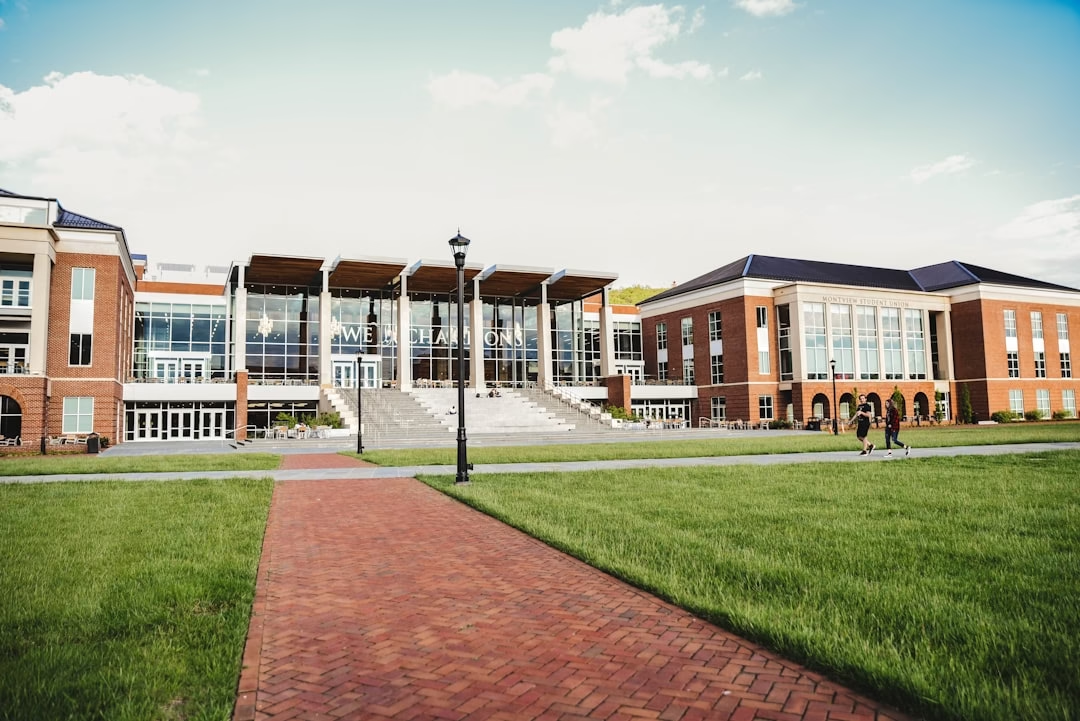
In the rapidly evolving landscape of higher education, universities and colleges are constantly seeking innovative ways to enhance efficiency, reduce costs, and improve sustainability. Building automation has emerged as a powerful solution to address these challenges, revolutionizing campus operations and creating smarter, more responsive educational environments. This technology integrates various systems within campus buildings, including heating, ventilation, and air conditioning (HVAC), lighting, security, and energy management, into a centralized, automated network.
Building automation systems (BAS) in higher education institutions leverage advanced sensors, controls, and software to monitor and manage campus facilities more effectively. These systems collect and analyze data from multiple sources, enabling facility managers to make informed decisions about resource allocation, energy consumption, and maintenance schedules. By optimizing campus operations, universities can significantly reduce operational costs, enhance energy efficiency, and improve the overall experience for students, faculty, and staff.
The importance of operational efficiency and sustainability on campuses cannot be overstated. With rising energy costs, increasing environmental concerns, and growing competition for students, universities must find ways to do more with less while maintaining a high-quality educational experience. Building automation offers a comprehensive solution to these challenges, allowing institutions to streamline their operations, reduce their carbon footprint, and create more comfortable and productive learning environments.
For example, a well-implemented building automation system can automatically adjust lighting and temperature settings based on occupancy and time of day, ensuring optimal comfort while minimizing energy waste. It can also provide real-time alerts for equipment malfunctions, allowing maintenance teams to address issues promptly and prevent costly breakdowns. Furthermore, by integrating with campus scheduling systems, BAS can optimize space utilization, ensuring that heating, cooling, and lighting are only activated when and where they are needed.
Benefits of Building Automation for Campus Operations
The implementation of building automation in higher education institutions offers a wide array of benefits that extend far beyond simple energy savings. These systems contribute significantly to operational cost reduction, enhanced energy efficiency, improved safety and security, and an overall better experience for students and staff.
One of the primary advantages of building automation is its ability to dramatically reduce operational costs. By optimizing energy use across campus buildings, universities can see substantial reductions in their utility bills. For instance, automated HVAC systems can adjust temperature settings based on occupancy and weather conditions, preventing unnecessary heating or cooling of empty spaces. Lighting systems can be programmed to dim or turn off when natural light is sufficient or when rooms are unoccupied, further reducing energy consumption.
Energy efficiency is another critical benefit of building automation. Advanced energy management software allows facility managers to monitor energy usage in real-time, identify inefficiencies, and implement corrective measures promptly. This level of control and insight can lead to significant reductions in a campus’s overall energy consumption and carbon footprint. Many universities that have implemented building automation systems report energy savings of 20-30% or more, contributing not only to cost savings but also to their sustainability goals.
Building automation also plays a crucial role in enhancing campus safety and security. Integrated security systems can provide centralized monitoring of access points, surveillance cameras, and emergency communication systems. In the event of an emergency, these systems can automatically lock down buildings, alert authorities, and guide occupants to safety through coordinated lighting and public address systems.
Furthermore, building automation significantly improves the student and staff experience on campus. Smart building technologies create more comfortable learning and working environments by maintaining optimal temperature and air quality levels. Automated lighting systems can adjust to natural light levels, reducing eye strain and improving focus. Even simple conveniences, such as automated door systems or smart room scheduling, can enhance the daily experience of campus life.
Role of Data Analytics in Optimizing Campus Operations
Data analytics plays a pivotal role in maximizing the benefits of building automation systems in higher education. By collecting and analyzing vast amounts of data from various sensors and systems across campus, universities can gain valuable insights into their operations, predict potential issues, and make data-driven decisions to optimize efficiency and sustainability.
The integration of data analytics with building automation systems enables predictive maintenance, a proactive approach that can significantly reduce downtime and maintenance costs. By analyzing data patterns from equipment sensors, the system can predict when a piece of equipment is likely to fail, allowing maintenance teams to address issues before they become critical. This approach not only prevents costly breakdowns but also extends the lifespan of campus infrastructure.
Various types of data are crucial for optimizing campus operations. Energy consumption data helps identify areas of high usage and opportunities for conservation. Occupancy data informs space utilization strategies and helps optimize HVAC and lighting schedules. Environmental data, such as indoor air quality measurements, ensures a healthy and comfortable learning environment. Even data from campus Wi-Fi networks can provide insights into foot traffic patterns, informing decisions about facility usage and resource allocation.
Data analytics can also predict and prevent potential issues in campus operations. For instance, by analyzing historical data and weather forecasts, the system can anticipate peak energy demand periods and automatically implement load-shedding strategies to avoid costly demand charges. Similarly, predictive analytics can help identify patterns that may indicate security risks, allowing for proactive measures to be taken.
Cost Reduction Strategies through Building Automation
Building automation offers numerous cost reduction strategies for higher education institutions. These strategies not only focus on immediate savings but also on long-term financial benefits, balancing the initial investment with substantial returns over time.
One of the most effective cost reduction strategies enabled by building automation is optimized energy management. Energy management software integrated with building automation systems provides real-time monitoring and control of energy consumption across campus. This allows facility managers to identify energy waste, implement conservation measures, and track the results of their efforts. For example, automated systems can adjust lighting and HVAC settings based on occupancy schedules, ensuring that energy is not wasted on empty classrooms or offices.
Universities can balance upfront costs with long-term savings in building automation investments through careful planning and phased implementation. While the initial cost of installing a comprehensive building automation system can be significant, the long-term savings in energy and operational costs often result in a positive return on investment within a few years. Many institutions choose to start with high-impact areas, such as large academic buildings or residence halls, and gradually expand the system across campus as budgets allow.
Energy management plays a crucial role in reducing operational costs. Advanced energy management software can provide detailed insights into energy consumption patterns, allowing facility managers to identify opportunities for savings. For instance, the software might reveal that certain buildings are using excessive energy during off-hours, prompting adjustments to scheduling or equipment settings. Some systems can even automatically negotiate with utility providers to secure the best rates based on usage patterns.
Energy Efficiency Improvements with Smart Technologies
Smart technologies are at the forefront of energy efficiency improvements on university campuses. These technologies, which include Internet of Things (IoT) devices, advanced sensors, and intelligent control systems, work in concert with building automation systems to dramatically reduce energy consumption while maintaining or improving comfort levels.
One of the latest smart technologies being implemented for energy management in higher education is the use of AI-powered energy optimization systems. These systems use machine learning algorithms to analyze historical energy usage data, weather forecasts, and building occupancy patterns to predict future energy needs and automatically adjust building systems for optimal efficiency. For example, the system might pre-cool a building overnight when energy rates are lower, reducing the cooling load during peak daytime hours.
Campuses can leverage IoT for better energy efficiency by deploying a network of smart sensors throughout their facilities. These sensors can monitor various parameters such as temperature, humidity, light levels, and occupancy in real-time. The data collected by these sensors feeds into the building automation system, allowing for precise control of HVAC and lighting systems. For instance, if sensors detect that a lecture hall is only half full, the system can automatically adjust the ventilation and cooling to match the actual occupancy, saving energy without compromising comfort.
Smart lighting systems are another key component of energy-efficient campuses. LED fixtures equipped with sensors and networked controls can adjust light levels based on natural light availability and occupancy. Some systems even allow individual control through smartphone apps, giving users the ability to personalize their lighting environment while still maintaining overall energy efficiency goals.
Future Trends in Campus Operations and Automation
As technology continues to evolve, the future of campus operations and automation looks increasingly sophisticated and integrated. Emerging trends promise to further enhance efficiency, sustainability, and the overall campus experience.
One of the most significant emerging trends is the application of artificial intelligence (AI) and machine learning in campus automation. These technologies have the potential to take building automation systems from reactive to truly predictive and adaptive. AI-powered systems can learn from historical data and real-time inputs to optimize building operations continuously. For example, an AI system might analyze class schedules, historical attendance data, and even factors like weather forecasts to predict building occupancy and adjust HVAC settings accordingly, maximizing both comfort and energy efficiency.
The Internet of Things (IoT) is set to play an even larger role in campus automation. As IoT devices become more affordable and powerful, universities will be able to deploy dense networks of sensors across their campuses, providing unprecedented levels of data granularity. This could enable micro-zoning of building systems, where individual rooms or even specific areas within rooms are controlled independently based on occupancy and use.
Another exciting trend is the integration of renewable energy sources with building automation systems. As more campuses invest in solar panels, wind turbines, and other renewable technologies, building automation systems will need to evolve to manage these variable energy sources efficiently. Smart grids that can balance energy demand with supply from both renewable and traditional sources will become increasingly common on university campuses.
Virtual and augmented reality technologies also hold promise for campus operations. These technologies could be used for everything from virtual campus tours to advanced maintenance training for facility staff. Imagine a maintenance technician using augmented reality glasses to see real-time data overlays and repair instructions while working on a piece of equipment.
However, with these advancements come new challenges. Cybersecurity will become an even more critical concern as campus systems become more interconnected. Universities will need to invest in robust security measures to protect their automated systems from potential cyber threats.
Data privacy is another area of concern, particularly as systems collect more detailed information about building usage and occupant behavior. Universities will need to develop clear policies and practices for data collection, storage, and use that respect individual privacy while still leveraging the benefits of data-driven decision making.
Despite these challenges, the future of campus operations looks bright. As automation technologies continue to advance, universities will be able to create increasingly efficient, sustainable, and responsive campus environments that enhance the educational experience for students and staff alike.
Campus buildings in higher education share many indoor air quality challenges with K-12 schools, but at larger scale and with more complex occupancy patterns. Lecture halls, labs, dining facilities, and administrative offices all have different ventilation requirements that vary significantly across the academic calendar. Continuous monitoring across all building types gives facilities teams the granular data needed to optimize HVAC operation for actual conditions rather than fixed schedules.
Nosy is a wireless environmental sensor platform that monitors CO2, temperature, humidity, tVOCs, and occupancy across educational buildings, with readings every five minutes and a web-based dashboard that shows conditions by building and zone. The platform uses a Bluetooth mesh network that requires no campus IT changes and installs in minutes per sensor. At a K-12 school in Rhode Island, continuous monitoring identified a 41% increase in student absenteeism correlated with periods of low indoor humidity, illustrating how much environmental conditions affect educational outcomes at all levels. More at Nosy for Schools.
Conclusion
Building automation is set to transform campus operations in higher education profoundly in the coming years. As universities face mounting pressures to reduce costs, improve sustainability, and enhance the campus experience, building automation offers a powerful solution that addresses all these needs simultaneously.
The key takeaways for universities looking to optimize their operations through building automation are clear:
1. Embrace comprehensive solutions: Building automation is most effective when it integrates multiple systems across campus, from HVAC and lighting to security and space management.
2. Leverage data analytics: The true power of building automation lies in its ability to collect and analyze vast amounts of data, enabling predictive maintenance and data-driven decision-making.
3. Focus on energy efficiency: Smart technologies and energy management systems can lead to significant cost savings and help universities meet their sustainability goals.
4. Plan for the future: As technologies like AI and IoT continue to evolve, universities should implement systems that are flexible and scalable to accommodate future advancements.
5. Engage the campus community: Successful building automation initiatives often involve educating and engaging students, faculty, and staff in energy-saving efforts.
The integration of sustainability and technology is crucial for the future of higher education campuses. Building automation not only helps universities reduce their environmental impact but also creates more comfortable, productive, and innovative learning environments. As campuses become smarter and more connected, they will be better equipped to adapt to changing educational needs and environmental challenges.
Optimizing campus operations with building automation is no longer just an option for higher education institutions—it’s a necessity. Those universities that embrace these technologies and strategies will be well-positioned to thrive in an increasingly competitive and resource-constrained environment, offering their students and staff a campus experience that is truly fit for the future.
