
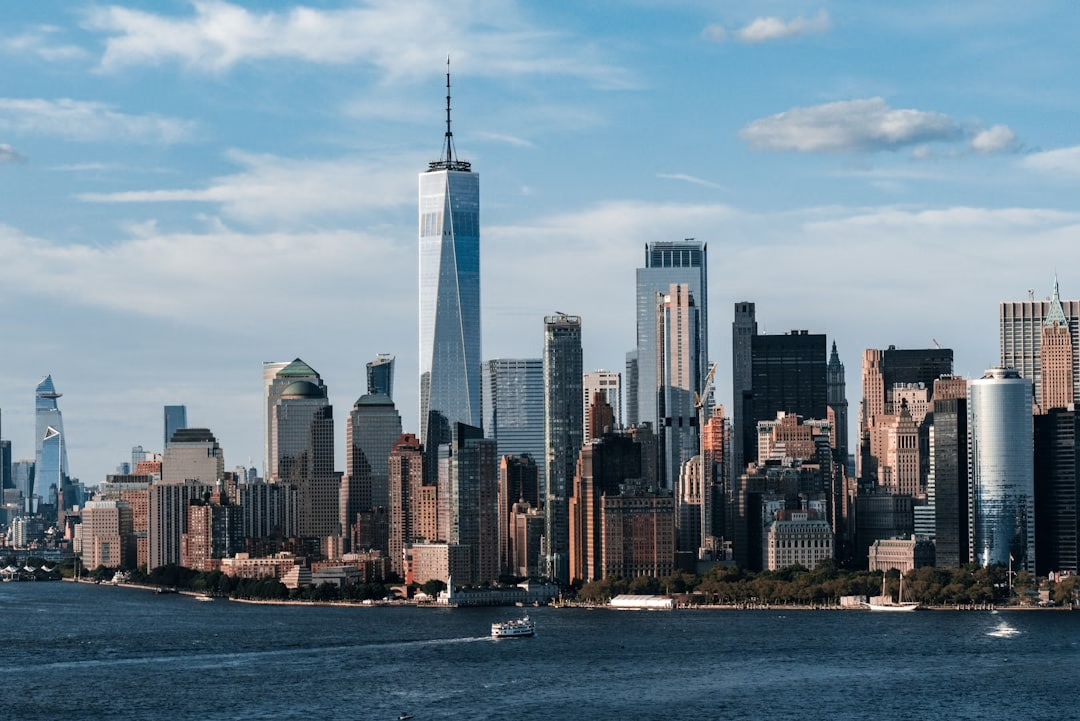
Introduction to Local Law 97
New York City faces a significant environmental challenge that demands immediate action. Buildings throughout New York produce roughly 70 percent of the city’s greenhouse gas emissions that contribute to climate change. This reality prompted city council leadership to take bold action through groundbreaking legislation. Local Law 97, known as LL97 compliance, emerged as a transformative response to New York City’s climate emergency and the urgency of addressing building emissions across the metropolis.
The introduction of Local Law 97 stems from a fundamental recognition that buildings represent the largest source of carbon emissions in urban environments. New York City policymakers understood that addressing climate change required direct intervention in the building sector. The New York City Council recognized that without mandatory requirements, voluntary efforts alone would not achieve the ambitious climate targets the city established for itself. Policymakers introduced this groundbreaking law to fundamentally reshape how buildings operate and consume energy throughout the entire city landscape.
Understanding the specific objectives of Local Law 97 proves essential for grasping its significance to climate action. The law targets large buildings exceeding 25,000 square feet, requiring property owners to meet increasingly stringent greenhouse gas emissions limits. These emissions limits become more rigorous across two critical benchmark years: 2024 and 2030. Building owners and covered buildings face real accountability through financial penalties for failing to meet these greenhouse gas emissions standards.
Local Law 97, part of the Climate Mobilization Act, fits into the broader context of climate change legislation as the city’s most ambitious building-focused climate policy. This overarching framework demonstrates that the New York City Council’s commitment to establishing a portfolio of climate initiatives rather than relying on single solutions. The law represents New York City’s determination to lead by example in urban climate action, setting ambitious targets that inspire other metropolitan areas to develop similar environmental protections. By positioning itself at the forefront of climate legislation, New York City signals that meaningful change requires decisive government action and structural reform of how covered buildings operate throughout the region.
The Role of Local Law 97 in Urban Sustainability
Local Law 97 contributes to urban sustainability by establishing mandatory mechanisms that drive energy efficiency improvements across the building stock in New York and New York State contexts. Real estate developers and building owners throughout New York City now recognize that sustainable practices are not optional but legally required under compliance requirements. This fundamental shift has catalyzed investment in green building technologies and building retrofits that might not have occurred without regulatory pressure from the New York City Council.
The implications of Local Law 97 for real estate developers and building owners extend far beyond simple compliance. Developers must now consider building energy efficiency during the initial design phase of new construction projects in New York. Existing property owners face difficult decisions about whether to invest in expensive retrofitting or face ongoing financial penalties for emissions limit violations. This duality creates two distinct business models within the real estate sector: those who embrace sustainability as a competitive advantage and those who resist compliance with New York City regulations.
Urban planners specifically benefit from Local Law 97’s structured approach to carbon emissions reduction throughout New York City. The law provides clear targets and timelines that allow urban planners to coordinate development strategies across neighborhoods and districts. Rather than proceeding with ad hoc building projects, urban planners can now align construction activities with measurable environmental outcomes. This coordination strengthens the overall effectiveness of climate resilience strategies and building emissions reduction efforts throughout the entire city.
Local Law 97 addresses carbon emissions reduction through a straightforward mechanism that impacts all covered buildings. Buildings that exceed designated emissions limits must either reduce their environmental impact or pay escalating fines to the city. This economic incentive structures decision-making around energy performance metrics for property owners across New York. Building owners quickly discover that investing in renewable energy sources, upgrading insulation, replacing aged mechanical systems, and installing advanced building automation systems often cost less than paying penalties year after year for non-compliance.
The future of urban climate legislation appears likely to follow the template established by New York City’s groundbreaking approach to climate action. Local Law 97 demonstrates that well-designed regulations can drive meaningful change without destroying economic productivity. Other major cities are studying NYC local law implementation closely, recognizing that similar building-focused regulations could achieve comparable emissions reduction results in their own jurisdictions. Environmental justice considerations increasingly inform how cities design climate legislation to ensure equitable distribution of costs and benefits.
Compliance and Penalties under Local Law 97
The compliance requirements of Local Law 97 create a detailed roadmap for building owners seeking to meet legal obligations imposed by the New York City Council. Buildings must undergo energy benchmarking, which involves tracking and publicly disclosing energy consumption data annually to demonstrate LL97 compliance. This transparency requirement ensures that building owners and tenants understand actual performance metrics for their properties. Beyond benchmarking, covered buildings must meet specific emissions limits or implement approved energy efficiency measures.
Penalties for failing to comply with Local Law 97 carry serious financial consequences that affect building profitability. Building owners who do not meet the designated emissions limits face fines ranging from thousands to hundreds of thousands of dollars annually for each compliance period. These penalties increase substantially for continued non-compliance with New York regulations, creating escalating pressure on building owners to address building emissions shortcomings. The penalty structure reflects city council’s determination to enforce compliance rather than treating the law as merely advisory guidance.
How can businesses prepare for Local Law 97 compliance? Property owners should begin by conducting comprehensive energy audits to understand current performance and identify improvement opportunities. Energy auditors play a crucial role in this process, analyzing building systems and recommending cost-effective modifications. Legal experts help property owners understand contractual implications and potential liability exposure. Environmental consultants guide owners through the technical details of emissions calculations and reporting requirements for covered buildings.
Buildings can pursue multiple pathways to compliance, offering flexibility to property owners with different financial and operational circumstances. Some buildings prioritize low-cost operational changes like optimizing heating and cooling schedules or reducing lighting energy consumption. Other property owners undertake major capital improvements such as replacing fossil fuel-based heating systems with electric alternatives or installing renewable energy sources like rooftop solar arrays. Still others combine modest operational improvements with targeted capital projects to achieve necessary greenhouse gas emissions reductions within available budgets.
The process of preparing for Local Law 97 compliance extends beyond technical considerations to encompass strategic planning for covered buildings. Building owners who began early LL97 compliance efforts now benefit from accumulated experience and established relationships with contractors and technology providers. Those delaying preparation face compressed timelines and potentially higher project costs as demand for qualified contractors increases throughout New York. Therefore, property owners view early preparation as a competitive advantage rather than an unnecessary burden on their operations.
Innovative Energy-Saving Technologies and Local Law 97
Innovative energy-saving technologies play a fundamental role in enabling all covered buildings to meet Local Law 97 emissions limits efficiently and cost-effectively. Advanced building automation systems represent one of the most cost-effective technological interventions available to property owners seeking LL97 compliance. These systems use artificial intelligence and machine learning algorithms to optimize heating, cooling, lighting, and ventilation based on actual occupancy patterns and weather conditions. Buildings implementing sophisticated automation systems often achieve 10 to 20 percent energy reductions without requiring extensive physical modifications to their structures.
Renewable energy sources contribute substantially to Local Law 97 compliance and overall carbon emissions reduction throughout New York City. Rooftop solar photovoltaic systems generate clean electricity while reducing dependence on grid power derived from fossil fuels. Urban buildings increasingly combine solar installations with battery storage systems, enabling power generation even during evening hours when solar output naturally declines. Wind turbines, geothermal heat pumps, and other renewable technologies also play supporting roles in comprehensive energy strategies, though solar installations remain most prevalent in urban building environments.
The benefits of energy-efficient buildings extend far beyond compliance with Local Law 97 requirements. Building owners discover that energy-efficient buildings attract premium tenants willing to pay higher rents for modern, comfortable, and environmentally responsible spaces throughout New York. Lower operating costs improve profit margins and increase property values in competitive real estate markets. Tenants working in green building environments report higher productivity levels and reduced respiratory illnesses, creating additional value through improved workforce performance and health outcomes. Insurance companies increasingly offer favorable rates for buildings demonstrating strong environmental performance and climate leadership in their operations.
Building emissions reduction measures represent another powerful tool for achieving compliance with LL97 regulations. Upgrading windows and doors reduces heat loss during winter months and heat gain during summer periods. Enhanced insulation in walls and roofs dramatically improves thermal performance of existing buildings. Replacing aging lighting fixtures with LED technology consumes far less electricity while providing superior illumination throughout properties. All these measures work together to reduce the total energy demands and greenhouse gas emissions of buildings throughout New York City.
Construction managers recognize that incorporating building energy efficiency during renovation projects yields far better results than attempting retrofits of completed structures. When buildings undergo planned maintenance or structural improvements, adding energy efficiency measures requires minimal additional disruption and labor cost. This integration approach makes green building upgrades economically attractive rather than prohibitively expensive. Therefore, forward-thinking property owners strategically time major renovations to align with Local Law 97 emissions reduction requirements and compliance deadlines.
Impact of Local Law 97 on New York City’s Climate Goals
Local Law 97 significantly advances New York City’s climate goals by targeting the sector responsible for the largest share of urban carbon emissions. The law directly addresses greenhouse gas reduction targets embedded within the city’s comprehensive Climate Mobilization Act and broader climate action initiatives. By requiring mandatory emissions limits across a broad swath of the covered buildings stock, Local Law 97 creates concentrated progress toward measurable climate objectives rather than relying solely on voluntary initiatives or gradual market transformation. New York has emerged as a leader in climate action through this comprehensive regulatory approach.
The future outlook for urban climate legislation in New York City post-Local Law 97 appears increasingly ambitious and expansive. Policymakers are evaluating expansion of compliance requirements to smaller buildings currently exempt from New York City regulations and emissions limits. Additional legislation addressing transportation carbon emissions, waste management, and food systems appears likely as the city builds momentum around climate action. Each successive policy builds on the political and technical foundation established by Local Law 97, creating a comprehensive framework for urban sustainability throughout New York.
Local Law 97 influences public health and climate change through multiple interconnected pathways affecting New Yorkers. Buildings burning natural gas or heating oil produce indoor and outdoor air pollutants that trigger respiratory diseases and cardiovascular complications. As buildings transition away from fossil fuel combustion, air quality improvements deliver immediate health benefits to residents and workers throughout New York City. Studies demonstrate that individuals working in green building environments powered by renewable energy experience fewer asthma attacks, reduced allergy symptoms, and improved cardiovascular function compared to those in traditional buildings. These public health improvements represent genuine economic benefits that complement environmental protections.
Urban planners observe that Local Law 97 catalyzes broader neighborhood transformation beyond simple building-level changes. As property owners invest in building energy efficiency improvements, communities benefit from associated upgrades to building exteriors, mechanical systems, and common areas. Neighborhoods hosting multiple LL97 compliance-driven renovation projects experience enhanced aesthetics, improved infrastructure reliability, and strengthened property values throughout the region. This multiplier effect suggests that Local Law 97 functions as an economic development tool alongside its environmental mission for New York.
Climate resilience strategies gain added importance under Local Law 97’s framework for covered buildings. Buildings forced to modernize their mechanical systems often incorporate resilience features simultaneously. Backup power systems keep critical facilities operational during grid failures. Improved insulation and mechanical systems enhance indoor temperature stability during extreme weather events. Water management systems reduce flooding risks. Therefore, compliance with LL97 frequently coincides with broader resilience improvements that protect communities against climate-related hazards throughout New York State.
Sustainable Building Practices and Local Law 97
Sustainable building practices flourish under Local Law 97 because the regulatory framework creates economic incentives for their adoption by property owners. Building owners exploring how Local Law 97 encourages sustainable practices discover that green building standards often exceed minimum compliance requirements. Architects and engineers now integrate sustainability principles throughout design processes rather than treating environmental performance as an afterthought. This cultural shift within the construction industry represents lasting change that extends beyond regulatory compliance requirements.
Cost-effective emissions reduction strategies form the practical foundation of successful Local Law 97 implementation across New York City. Building owners quickly identify that certain improvements deliver emissions limits compliance at relatively modest cost. Weatherization measures sealing air leaks through doors, windows, and wall penetrations cost little compared to major mechanical system overhauls yet produce measurable energy reductions. Commissioning building automation systems to operate more efficiently requires only software adjustments. Tenant education programs promoting behavioral changes cost virtually nothing while contributing meaningfully to overall carbon emissions reductions in buildings.
Sustainable materials for construction gain prominence as builders recognize their role in comprehensive environmental strategies and climate action. Low-embodied-carbon materials like sustainably harvested wood, recycled steel, and rapidly renewable bamboo reduce the environmental impact associated with building construction itself. These materials often perform as well or better than conventional alternatives while supporting broader climate initiatives. As demand for sustainable materials increases, markets expand and prices become increasingly competitive with conventional building options.
Local Law 97 effectively functions as a driver of innovation within the construction and building management industries throughout New York. Contractors develop specialized expertise in energy retrofitting and renewable energy installation for covered buildings. Technology companies create sophisticated monitoring systems providing real-time building emissions and performance data. Engineering firms develop creative solutions tailored to unique building characteristics and property owner circumstances. This innovation ecosystem creates employment opportunities while advancing environmental objectives and climate action goals.
Architecture professionals recognize that sustainable building design principles now drive decisions about building orientation, window placement, thermal mass characteristics, and ventilation strategies. Modern buildings incorporate green building elements that reduce mechanical system demands without sacrificing occupant comfort. These principles learned in architecture schools now extend throughout professional practice as practitioners internalize the reality that building energy efficiency fundamentally shapes building design success and compliance with Local Law 97 requirements.
Legal Implications and Future of Climate Legislation
The legal implications of Local Law 97 for New York businesses extend into multiple domains requiring professional guidance and expertise. Real estate attorneys must advise clients about lease structures that appropriately allocate LL97 compliance costs between landlords and tenants. Environmental consultants help building owners understand technical requirements and documentation procedures for emissions limits compliance. Contractors need clarity about liability exposure if their building work fails to deliver promised greenhouse gas emissions reductions. Financial advisors guide property owners through cost-benefit analyses of various compliance pathways. This complex legal environment has spawned specialized professional services supporting property owners throughout New York in meeting climate action requirements.
Future urban climate legislation appears likely to build directly upon the template established by Local Law 97. Policymakers in cities worldwide study New York City’s implementation, recognizing that similar regulatory approaches could drive carbon emissions reductions in their own jurisdictions. The apparent success of building-focused regulations suggests that future climate legislation will expand coverage to additional building sizes and expand emissions limits to increasingly ambitious levels. Cities will likely coordinate their individual regulations to create regional consistency and avoid disadvantaging particular jurisdictions in climate action efforts.
Lessons for other cities emerge clearly from New York City’s Local Law 97 experience and implementation trajectory. First, precise emissions measurement and transparency requirements prove essential for effective climate action and compliance monitoring. Second, providing multiple compliance pathways accommodates the diverse circumstances of real estate portfolios with varying age, condition, and property owner resources. Third, phased compliance timelines provide building owners reasonable time for planning and investment decisions. Fourth, establishing clear penalty structures creates genuine incentives for LL97 compliance. These lessons appear transferable to any jurisdiction attempting to reduce building sector carbon emissions through regulatory mechanisms.
Legal compliance experts recognize that Local Law 97 creates cascading effects throughout real estate transactions and financing arrangements. Property appraisals now incorporate building energy efficiency and emissions performance metrics affecting property valuations. Commercial mortgage underwriting increasingly scrutinizes LL97 compliance history and emissions risk. Insurance carriers adjust premiums based on building environmental performance and climate leadership. Property purchase agreements increasingly include representations and warranties regarding Local Law 97 status. These market-level adaptations demonstrate how single pieces of climate legislation reshape entire industries and professions.
Urban climate policy updates and environmental regulations continue evolving as experience accumulates regarding Local Law 97 implementation. Early compliance data informs policymakers about effectiveness, unexpected consequences, and opportunities for refinement. Stakeholder feedback from building owners, property owners, developers, tenants, and environmental advocates shapes ongoing policy development. This iterative process suggests that climate legislation need not be static but rather can improve continuously as implementation provides new insights and information for future climate action initiatives.
Local Law 97 was designed to create a structural incentive for building owners to reduce carbon emissions, not just meet minimum energy codes. The law places the compliance burden on buildings where efficiency improvements are most achievable, those with significant HVAC and conditioning loads that can be optimized with the right operational data. Understanding current energy use patterns is a prerequisite for any meaningful reduction strategy, and that requires continuous monitoring of the building parameters that drive energy consumption.
Nosy monitors occupancy, temperature, humidity, CO2, and tVOCs across commercial buildings, delivering readings every five minutes and providing the kind of continuous environmental data that informs both day-to-day operational decisions and long-term capital planning for compliance. Buildings that can document actual occupancy patterns and environmental conditions by zone are better positioned to identify where efficiency improvements will have the most impact. For more on how sensor-based monitoring supports LL97 strategies, see Nosy for Offices.
Conclusion
Local Law 97 represents a watershed moment in urban environmental policy by demonstrating that mandatory regulations can effectively drive building emissions reductions while maintaining economic productivity. The key takeaways from why Local Law 97 was introduced underscore several critical principles applicable to climate action broadly. First, clear emissions limits and regulatory requirements create stronger incentives for behavior change than voluntary climate programs alone. Second, providing multiple compliance pathways accommodates diverse circumstances while maintaining accountability. Third, transparent measurement and reporting systems prove essential for demonstrating progress and maintaining public confidence in climate initiatives.
Local Law 97 serves as a model for future climate legislation by establishing practical mechanisms for achieving ambitious carbon emissions reduction targets. The law demonstrates that urban climate action need not choose between environmental protection and economic vitality. Instead, well-designed building regulations catalyze innovation, create employment opportunities, and improve public health while advancing climate objectives. Cities worldwide examining New York City’s experience with LL97 compliance gain confidence that similar regulatory approaches to climate action can work in their own contexts.
The broader implications of Local Law 97 for urban sustainability and climate action extend far beyond New York City’s boundaries. The law affirms that cities can take meaningful climate action independent of state or federal inaction. It establishes that building emissions regulations represent powerful climate tools deserving prominent placement in environmental policy strategies. Most importantly, Local Law 97 demonstrates that when policymakers commit to clear emissions limits, appropriate enforcement mechanisms, and reasonable compliance timelines, significant greenhouse gas reductions become achievable. This success provides hope that urban communities worldwide can pursue ambitious climate action through building regulation while supporting economic prosperity and improving quality of life for all residents and building occupants.
