
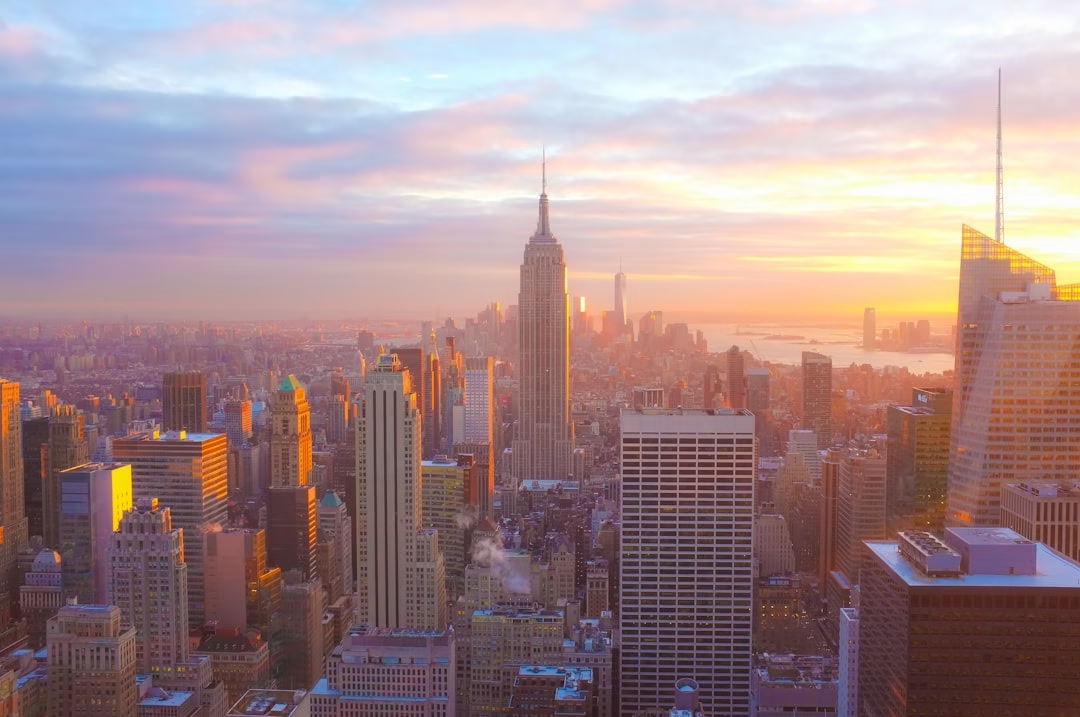
Introduction to Local Law 97
Local Law 97 represents a significant environmental legislation that New York City enacted to address pressing climate challenges. This groundbreaking law specifically targets greenhouse gas emissions from large buildings across the city. Understanding what Local Law 97 in New York City aims to achieve requires examining its core objectives and broader environmental context.
The New York City Council designed Local Law 97 as part of the comprehensive Climate Mobilization Act. This legislation directly responds to the reality that buildings account for nearly 70 percent of the city’s total greenhouse gas emissions. Rather than focusing on transportation or industry alone, policymakers recognized that addressing building emissions would create meaningful climate progress. The law establishes specific emissions reduction targets that building owners must meet during designated compliance periods.
New York City stands at the forefront of urban sustainability efforts, and Local Law 97 serves as a key component of the city’s broader climate action plan. The law applies to covered buildings, which are defined as structures exceeding 25,000 square feet. This threshold captures most commercial office buildings, apartments, hotels, and institutional facilities throughout the five boroughs. By targeting these larger structures, the legislation influences a significant portion of the city’s built environment.
Local Law 97 fits into a global conversation about urban sustainability initiatives and environmental responsibility. Cities worldwide face similar challenges regarding carbon emissions and energy consumption. New York’s approach provides a model that other municipalities can adapt to their own contexts. The law demonstrates that local legislation can drive meaningful climate action even as nations struggle with international climate agreements. Building owners, real estate developers, and sustainability consultants must understand how this law connects to worldwide environmental goals.
The legislative background reveals thoughtful planning by New York City policymakers. Environmental advocates pushed for stronger emissions regulations after years of advocacy. Real estate developers initially resisted but eventually adapted their business models to compliance requirements. This collaborative approach shaped a law that balances environmental protection with economic feasibility. The goals of Local Law 97 within New York City’s climate action plan emphasize reducing carbon emissions by 80 percent by 2050. The law represents an essential stepping stone toward this ambitious target.
Understanding Local Law 97 requires recognizing its connection to global urban sustainability efforts. International organizations have emphasized that cities must lead climate action at the local level. New York City’s commitment through Local Law 97 demonstrates municipal leadership in combating climate change. The importance of local legislation in addressing climate challenges cannot be overstated. National and international approaches move slowly, while cities can implement changes rapidly. Local Law 97 proves that municipalities can create enforceable environmental standards that produce measurable results.
Key Components and Requirements of Local Law 97
Local Law 97 establishes specific requirements that apply to covered buildings throughout New York City. Building owners must understand these requirements to develop effective compliance strategies. The law creates emissions caps that decrease over time, forcing continuous improvement in building performance. These caps apply to all covered buildings starting with the first compliance period from 2024 to 2029.
The specific requirements of Local Law 97 for buildings include meeting established emissions limits based on building type and size. The law measures emissions in metric tons of carbon dioxide equivalent per square foot annually. Different building categories face different emissions intensity limits. For example, office buildings have different requirements than multifamily residential buildings. Hotels, retail spaces, and other building types each have tailored benchmarks reflecting their typical energy consumption patterns. Building owners must conduct energy audits to determine current performance levels and identify improvement areas.
Energy efficiency standards under Local Law 97 represent significant advancements compared to previous regulations. Earlier building codes focused primarily on new construction rather than retrofitting existing buildings. Local Law 97 directly addresses the existing building stock, which represents the overwhelming majority of New York City’s structures. The law’s standards exceed those in comparable cities and rival international best practices. Compliance requires implementing energy-saving technologies such as upgraded HVAC systems, improved insulation, LED lighting retrofits, and advanced building automation systems. These improvements generate long-term cost savings through reduced energy consumption even as they require substantial upfront investment.
Timeline and milestones for compliance create a phased approach that allows building owners time to plan and execute necessary improvements. The first compliance period runs from 2024 through 2029, establishing baseline emissions levels. During this period, building owners must measure and report their emissions without facing immediate penalties. This grace period allows stakeholders to understand performance levels and begin developing improvement plans. The second compliance period spans 2030 to 2034, when emissions must decline to 40 percent below 2005 baseline levels. The third period, 2035 to 2039, requires further reductions to 50 percent below baseline. The fourth and final period, 2040 to 2049, mandates 80 percent emissions reductions. This extended timeline emphasizes the importance of early preparation for building owners who want to avoid penalties and maintain property values.
Emission limits under Local Law 97 are calculated based on building-specific factors including size, location, and function. The city provides detailed benchmarking data and calculation methodologies to help owners understand their requirements. Buildings that exceed their assigned emissions limits must pay penalties, creating financial incentive for compliance. However, the law also includes flexibility mechanisms such as renewable energy credits and sustainability certification programs. Building owners can offset emissions through on-site renewable energy generation or by purchasing renewable energy credits from external sources. These mechanisms recognize that some buildings face physical or financial constraints preventing complete emissions elimination.
Impact on Real Estate Market
Local Law 97 fundamentally reshapes New York City’s real estate landscape and creates both challenges and opportunities for market participants. Understanding how Local Law 97 influences the real estate market requires examining property values, development costs, and overall market dynamics. The law forces real estate stakeholders to consider long-term sustainability implications rather than focusing solely on short-term profits.
The potential effects of Local Law 97 on property values remain complex and multifaceted. Properties that comply with emissions requirements and achieve high energy efficiency ratings may command premium prices. Conversely, buildings that cannot meet compliance standards without expensive retrofitting face potential devaluation. This dynamic creates winners and losers in the real estate market, rewarding building owners who invest in sustainability. Tenant preferences increasingly favor energy-efficient buildings with lower operating costs and modern amenities. Forward-thinking developers recognize that sustainability drives long-term property value appreciation and tenant retention.
Development costs rise substantially when real estate developers must incorporate Local Law 97 compliance into project planning. New construction projects face the challenge of designing buildings that meet or exceed efficiency requirements from opening day. Existing building owners confront expensive retrofit projects, often requiring specialized contractors and advanced technology implementation. However, these upfront costs frequently translate into operational savings through reduced energy consumption. Building owners recoup investments through lower utility bills over time. Additionally, federal and state grants, loans, and tax incentives help offset retrofit expenses, making compliance more financially achievable.
Market dynamics shift as Local Law 97 encourages innovation in sustainable building practices and green technologies. Real estate developers increasingly partner with sustainability consultants to optimize building performance. Energy audits become standard practice rather than optional extras. The retrofit industry experiences growth as contractors gain expertise in implementing efficiency improvements. Property managers face new responsibilities for monitoring building performance and maintaining compliance. These market changes create both disruption and opportunity for real estate professionals.
Real estate developers navigate Local Law 97 by viewing sustainability as a competitive advantage rather than a regulatory burden. Developers who embrace sustainable building practices attract environmentally conscious investors and tenants. Buildings with demonstrated efficiency improvements and lower operating costs appeal to institutional investors seeking long-term stable returns. The challenge lies in balancing compliance costs against revenue generation and project timelines. Successful developers integrate sustainability planning from initial project conception rather than adding it as an afterthought.
Real estate stakeholders adapt to Local Law 97 through several strategic approaches. Building owners prioritize energy audits to identify cost-effective efficiency improvements. They invest in renewable energy integration, such as rooftop solar panels or participation in community solar programs. Property managers implement advanced building automation systems that optimize energy consumption. Real estate investors increasingly factor emissions compliance and sustainability performance into acquisition decisions. Legal advisors help clients understand their obligations and navigate complex compliance requirements.
Penalties for Non-Compliance and Compliance Strategies
Building owners who fail to comply with Local Law 97 face substantial financial penalties that increase severity over time. Understanding these penalties emphasizes why compliance matters financially and operationally. The city imposes annual fines based on the extent of emissions exceedances, with penalties ranging from hundreds to hundreds of thousands of dollars for large buildings.
Non-compliance penalties create significant financial and reputational risks for building owners and operators. Buildings that exceed their emissions limits must pay $268 per ton of carbon dioxide equivalent above their assigned cap. For a large building exceeding limits by 100 tons annually, annual penalties reach approximately $26,800. These penalties are not one-time costs but rather recurring annual charges that accumulate indefinitely. Over a decade, a non-compliant building could face penalties exceeding $250,000 or more. Beyond financial penalties, non-compliant buildings face reputational damage as the city publicly reports emissions violations. This public disclosure affects investor confidence, tenant attraction, and property value appreciation.
Comprehensive compliance strategies help building owners and managers ensure adherence to Local Law 97 requirements. Conducting professional energy audits represents the essential first step in developing effective compliance plans. Energy auditors use specialized equipment and expertise to identify performance issues and efficiency opportunities. These audits typically cost between $2,000 and $5,000 but provide detailed roadmaps for achieving compliance. Retrofitting represents the most significant compliance strategy, involving systematic upgrades to building systems and components. Common retrofits include upgrading to high-efficiency HVAC systems, improving insulation and air sealing, installing LED lighting throughout the building, and implementing advanced building controls.
Renewable energy sources offer another critical pathway toward compliance for many building owners. On-site solar installation provides clean energy that directly reduces building emissions. Many building owners install rooftop solar systems that generate electricity for on-site consumption and potentially feed excess power back to the grid. Community solar programs allow building owners without suitable rooftops to participate in solar projects and receive credits. Geothermal heating systems provide efficient climate control by leveraging stable underground temperatures. Wind power, though less common in urban environments, offers another renewable option for certain buildings.
Government and private sector resources significantly assist building owners pursuing Local Law 97 compliance. The NYC Accelerator program provides direct support to building owners implementing emissions reduction projects. This initiative offers technical assistance, financing solutions, and project management support. Federal grants and tax credits help offset retrofit costs. The Inflation Reduction Act provided substantial new funding for building efficiency improvements. The New York State Energy Research and Development Authority (NYSERDA) offers rebates, incentives, and financing programs. Private sector lenders increasingly offer green financing options with favorable terms for sustainability projects. These diverse resources make compliance financially achievable for most building owners.
Future Implications for Urban Sustainability Legislation
Local Law 97 serves as a powerful model for future urban sustainability laws at local, state, and national levels. Policymakers throughout the United States and globally watch New York City’s implementation with keen interest. The law demonstrates that meaningful climate action is achievable through local legislation despite resistance from some stakeholders. Cities seeking to address climate change increasingly look to New York’s approach for inspiration and practical guidance.
Local Law 97 as a model for future legislation reveals several key lessons that other jurisdictions can adapt. The law’s focus on existing buildings rather than only new construction proved controversial but ultimately essential for impact. Existing buildings represent the vast majority of urban structures and will dominate the built environment for decades. New legislation in other cities is increasingly adopting this comprehensive approach. The phased compliance timeline in Local Law 97 demonstrates that realistic timelines improve rather than diminish compliance rates. Building owners respond better to extended timelines that allow for strategic planning and capital allocation. The emissions intensity standards used in Local Law 97 prove more effective than simple percentage reductions because they account for building-specific characteristics.
The potential ripple effect of Local Law 97 on other jurisdictions is already becoming apparent. Several other major cities have introduced similar legislation or are actively considering comparable measures. Boston, Washington D.C., and Seattle all have emissions reduction laws modeled partly on New York’s approach. International cities including London and Paris are adopting comparable building emissions standards. This spread demonstrates that Local Law 97 transcends New York City’s unique context to address universal urban sustainability challenges. As more cities adopt similar measures, building owners operating in multiple markets must navigate increasingly complex compliance landscapes. However, this proliferation of sustainable building standards also accelerates the development and deployment of efficiency technologies.
New York City’s comprehensive climate action plan extends well beyond Local Law 97 to address sustainability holistically. The city commits to emissions reductions across transportation, waste management, and energy generation sectors. Future legislative and policy directions emphasize transitioning the entire city to renewable energy sources. The plan includes initiatives to ensure that climate benefits reach all communities, particularly lower-income neighborhoods disproportionately affected by pollution. Green infrastructure investments aim to increase urban tree canopy and create climate resilience against extreme weather. Public health initiatives recognize the direct connection between emissions reductions and improved air quality and health outcomes.
Conclusion
Local Law 97 fundamentally advances New York City’s urban sustainability goals through systematic emissions reduction from the building sector. The legislation creates a powerful incentive structure that encourages building owners to invest in efficiency improvements and renewable energy. By establishing clear emissions targets and timelines, the law provides the regulatory certainty necessary for long-term investment in building sustainability. The market response has proven that compliance is achievable when coupled with technical support and financing assistance.
Key takeaways for stakeholders affected by Local Law 97 emphasize the importance of early action and strategic planning. Building owners should conduct energy audits immediately to understand current performance levels. Real estate developers must integrate sustainability into project planning from inception rather than retrofitting after construction. Architects and sustainability consultants should develop expertise in Local Law 97 compliance to serve growing demand. Environmental advocates should continue pushing for stronger standards while recognizing the law’s significant achievements. Policy makers should study Local Law 97’s implementation to refine approaches and consider broader emissions reduction strategies.
Local Law 97 shapes the future of urban development and sustainability in New York City by creating permanent market incentives for building efficiency. The law will drive sustained investment in retrofit technologies and renewable energy deployment over the next two decades. Building standards will continue improving as the city approaches its 2050 emissions reduction target. Future generations of New Yorkers will inherit a more sustainable, energy-efficient built environment. This outcome represents the intended consequence of thoughtful policy design that balances environmental protection with economic feasibility. The significance of Local Law 97 extends far beyond New York City to demonstrate that cities can lead global climate action through decisive local legislation.
