
Introduction to Environmental History Tracking
Environmental history tracking has emerged as a crucial tool for sustainable practices in blending and storage operations. This innovative approach involves the systematic collection, analysis, and interpretation of historical environmental data to inform decision-making processes and drive sustainability efforts. By leveraging long-term environmental records, organizations can gain valuable insights into ecological trends, identify patterns, and make informed choices that minimize environmental impact while optimizing operational efficiency.
The significance of environmental history tracking lies in its ability to provide a comprehensive understanding of the complex relationships between human activities and the natural environment over time. This historical perspective allows decision-makers to contextualize current environmental challenges and develop more effective strategies for sustainable blending and storage practices. By analyzing past environmental data, organizations can identify cause-and-effect relationships, anticipate potential issues, and implement proactive measures to mitigate negative impacts.
Environmental history tracking contributes to sustainability efforts in several ways. Firstly, it enables organizations to establish baseline conditions and track progress towards environmental goals. By comparing current environmental metrics with historical data, companies can assess the effectiveness of their sustainability initiatives and make necessary adjustments. Secondly, it facilitates the identification of long-term trends and patterns that may not be apparent in short-term observations. This broader perspective helps in developing more robust and adaptable environmental management strategies.
The process of environmental history tracking involves various data collection methods, ranging from traditional field surveys to advanced remote sensing technologies. These methods include soil sampling, water quality monitoring, air pollution measurements, and ecosystem assessments. The advent of real-time environmental monitoring systems has further enhanced the ability to collect and analyze data continuously, providing up-to-date information for decision-making.
Sustainable data management practices play a crucial role in environmental history tracking. Organizations must implement robust data storage and retrieval systems to ensure the long-term accessibility and integrity of historical environmental records. This includes the use of standardized data formats, regular backups, and secure storage solutions. Additionally, data quality assurance and validation procedures are essential to maintain the reliability and accuracy of the collected information.
The Role of Geographic Information Systems in Environmental Data Analysis
Geographic Information Systems (GIS) have revolutionized the field of environmental data analysis, offering powerful tools for integrating, visualizing, and interpreting spatial and temporal environmental data. GIS technologies enhance environmental history tracking by providing a spatial context to historical data, allowing for more comprehensive and nuanced analyses of environmental trends and patterns.
The integration of GIS with environmental history tracking enables organizations to create detailed maps and visualizations that illustrate changes in environmental conditions over time. These visual representations make it easier for decision-makers to identify areas of concern, assess the spatial distribution of environmental impacts, and develop targeted strategies for sustainable blending and storage operations. For example, GIS can be used to map historical land use changes, track the spread of pollutants, or visualize the evolution of ecosystems in response to human activities.
GIS plays a crucial role in data-driven environmental decisions by facilitating the analysis of complex spatial relationships. By overlaying multiple layers of environmental data, decision-makers can identify correlations between different environmental factors and human activities. This multi-dimensional approach allows for a more holistic understanding of environmental challenges and supports the development of integrated solutions.
In the context of blending and storage operations, GIS can significantly improve efficiency and sustainability. For instance, GIS-based analysis can help optimize the siting of storage facilities by considering factors such as proximity to sensitive ecosystems, potential exposure to natural hazards, and accessibility to transportation networks. By incorporating historical environmental data into these analyses, organizations can make more informed decisions that minimize long-term environmental risks and maximize operational efficiency.
GIS also plays a vital role in the development and tracking of environmental sustainability metrics. By integrating various data sources and providing spatial context, GIS enables organizations to create more comprehensive and meaningful sustainability indicators. These metrics can be used to assess progress towards environmental goals, compare performance across different regions or facilities, and communicate environmental performance to stakeholders.
The application of GIS in resource management extends beyond environmental data analysis. It also supports sustainable practices by optimizing resource allocation and utilization. For example, in the context of blending operations, GIS can be used to analyze the spatial distribution of raw materials, transportation networks, and processing facilities to minimize energy consumption and reduce environmental impacts associated with logistics.
Leveraging Real-Time Environmental Monitoring
Real-time environmental monitoring has emerged as a game-changer in environmental management, offering unprecedented advantages for decision-making in blending and storage operations. This approach involves the continuous collection and analysis of environmental data, providing up-to-the-minute information on various environmental parameters such as air quality, water quality, noise levels, and weather conditions.
The primary advantage of real-time monitoring lies in its ability to provide immediate insights into environmental conditions, allowing for rapid response to potential issues. This timely information enables organizations to make quick, informed decisions to prevent or mitigate environmental impacts. For instance, in a blending operation, real-time monitoring of air quality can alert operators to sudden increases in emissions, prompting immediate adjustments to the process to reduce pollution.
Real-time data can significantly enhance blending and storage strategies by enabling dynamic optimization of operations. By continuously monitoring environmental conditions, organizations can adjust their processes in real-time to maintain optimal efficiency while minimizing environmental impact. For example, in a storage facility, real-time monitoring of temperature and humidity can guide automated climate control systems to maintain ideal conditions for stored materials while minimizing energy consumption.
However, implementing real-time environmental monitoring systems comes with its own set of challenges. One of the primary obstacles is the technical complexity of setting up and maintaining a network of sensors and data transmission systems. This requires significant investment in hardware, software, and infrastructure, as well as ongoing maintenance and calibration to ensure data accuracy and reliability.
Another challenge lies in data management and interpretation. Real-time monitoring systems generate vast amounts of data, which can be overwhelming to process and analyze effectively. Organizations need to implement robust data management practices and advanced analytics tools to extract meaningful insights from the constant stream of information.
Despite these challenges, the benefits of real-time environmental monitoring make it an invaluable tool for sustainable data management practices. By providing a continuous, detailed picture of environmental conditions, real-time monitoring supports data-driven environmental strategies that are more responsive, adaptive, and effective than traditional approaches.
The integration of real-time monitoring with environmental impact assessment tools can further enhance decision-making processes. These tools can use real-time data to model and predict potential environmental impacts of different operational scenarios, allowing decision-makers to evaluate alternatives and choose the most sustainable course of action.
Advances in data analytics in environmental science have also expanded the potential applications of real-time monitoring data. Machine learning algorithms, for example, can analyze patterns in real-time data to predict future environmental conditions or detect anomalies that may indicate emerging environmental issues. This predictive capability enables organizations to take proactive measures to prevent environmental problems before they occur.
Data-Driven Decisions in Environmental Management
Data-driven decision-making has become a cornerstone of effective environmental management, revolutionizing how organizations approach sustainability and operational efficiency. By leveraging comprehensive environmental data, including historical records and real-time information, decision-makers can develop more accurate, targeted, and effective strategies for managing environmental impacts.
The role of data in optimizing blending and storage operations cannot be overstated. By analyzing environmental data alongside operational metrics, organizations can identify correlations between specific processes and environmental outcomes. This insight allows for the fine-tuning of operations to minimize negative impacts while maintaining or improving productivity. For example, data analysis might reveal that certain blending techniques result in lower emissions without compromising product quality, leading to the adoption of more sustainable practices.
Implementing data-driven strategies effectively requires a systematic approach. Organizations should start by clearly defining their environmental goals and identifying the key metrics that will indicate progress towards these objectives. This step ensures that data collection and analysis efforts are focused on the most relevant information.
Next, organizations need to establish robust data collection systems that capture a wide range of environmental parameters. This may involve integrating data from various sources, including on-site sensors, remote sensing technologies, and external databases. Ensuring data quality and consistency is crucial for reliable analysis and decision-making.
Data analysis is at the heart of the data-driven approach. Organizations should invest in advanced analytics tools and techniques, such as statistical modeling, machine learning, and predictive analytics. These tools can help uncover hidden patterns, predict future trends, and simulate different scenarios to inform decision-making.
It’s also essential to create a data-driven culture within the organization. This involves training staff at all levels to understand and use environmental data in their decision-making processes. Regular reporting and visualization of environmental data can help make this information more accessible and actionable for all stakeholders.
Case studies have demonstrated the power of data-driven environmental management. For instance, a large chemical manufacturing company implemented a data-driven approach to reduce its water consumption. By analyzing historical water usage data alongside production metrics and local climate information, the company identified opportunities for process optimization and water recycling. As a result, they achieved a 30% reduction in water consumption without impacting production output.
Another example comes from the energy sector, where a power generation company used data analytics to optimize its operations for reduced emissions. By analyzing real-time emissions data, weather patterns, and electricity demand, they developed a predictive model that allowed them to adjust their generation mix dynamically. This approach led to a significant reduction in overall emissions while maintaining reliable power supply.
These case studies highlight how data-driven decisions can lead to tangible improvements in environmental performance and operational efficiency. By leveraging environmental history tracking and real-time data, organizations can make more informed, proactive decisions that support their sustainability goals while also driving business success.
Challenges in Integrating Environmental Data
While the potential benefits of data-driven environmental management are clear, organizations often face significant challenges in integrating environmental data effectively into their decision-making processes. These challenges can hinder the full realization of data’s potential in driving sustainable practices, particularly in complex operations such as blending and storage.
One of the primary challenges is data heterogeneity. Environmental data often comes from diverse sources, each with its own formats, resolutions, and measurement units. For instance, historical records might be in paper format, while recent data is digital. Satellite imagery might provide broad coverage but at a lower resolution than ground-based sensors. Integrating these disparate data types into a cohesive dataset for analysis can be technically challenging and time-consuming.
Data quality and reliability present another significant hurdle. Environmental data can be affected by various factors, including measurement errors, equipment malfunctions, and changes in monitoring protocols over time. Ensuring the accuracy and consistency of data across long periods is crucial for meaningful historical analysis but can be difficult to achieve in practice.
The sheer volume of environmental data can also be overwhelming. With the proliferation of sensors and monitoring systems, organizations often find themselves dealing with massive datasets that require significant computational resources to process and analyze effectively. This “big data” challenge necessitates robust data management systems and advanced analytics capabilities.
Temporal and spatial scale mismatches can complicate data integration efforts. Environmental processes occur at various scales, from local to global, and over different time frames. Aligning data collected at different scales to provide a comprehensive view of environmental conditions can be technically challenging and may require sophisticated modeling approaches.
In the context of blending and storage operations, these challenges can manifest in several ways. For example, integrating real-time monitoring data with historical records to identify long-term trends while also responding to immediate environmental concerns requires a carefully designed data management and analysis system. Similarly, combining environmental data with operational metrics to optimize processes for sustainability can be complex, requiring cross-functional collaboration and integrated data systems.
To overcome these challenges, organizations can adopt several strategies. Investing in standardized data collection and management protocols can help ensure consistency and compatibility across different data sources. Implementing robust data quality assurance and validation procedures is essential to maintain the reliability of integrated datasets.
Advanced data integration technologies, such as data lakes and cloud-based platforms, can help manage large volumes of diverse data more effectively. These solutions can provide the scalability and flexibility needed to handle complex environmental datasets while enabling easier access and analysis.
Machine learning and artificial intelligence technologies are playing an increasingly important role in solving data integration challenges. These tools can help automate data cleaning and harmonization processes, identify patterns and anomalies in large datasets, and even fill gaps in data through predictive modeling.
Collaboration and data sharing initiatives within industries and across sectors can also help address data integration challenges. By pooling resources and expertise, organizations can develop more comprehensive and standardized approaches to environmental data management.
The role of technology in solving these integration issues cannot be overstated. Advances in sensor technology, IoT (Internet of Things) platforms, and edge computing are making it easier to collect and process environmental data in real-time. Meanwhile, developments in cloud computing and big data analytics are providing the tools needed to handle and analyze large, complex environmental datasets effectively.
Future Trends in Environmental Data Analysis and Management
As we look to the future, several emerging trends are poised to reshape environmental data analysis and management, with significant implications for sustainable blending and storage strategies. These trends reflect ongoing technological advancements, evolving regulatory landscapes, and growing recognition of the importance of data-driven approaches in addressing environmental challenges.
One of the most promising trends is the increasing use of artificial intelligence (AI) and machine learning in environmental data analysis. These technologies are enabling more sophisticated pattern recognition, predictive modeling, and automated decision-making processes. For example, AI algorithms can analyze vast amounts of historical environmental data to predict future trends, identify early warning signs of environmental issues, and even suggest optimal strategies for mitigating impacts.
The integration of blockchain technology in environmental data management is another emerging trend. Blockchain can provide a secure, transparent, and immutable record of environmental data, enhancing traceability and accountability in environmental monitoring and reporting. This could be particularly valuable in blending and storage operations, where maintaining a verifiable record of environmental performance is crucial for regulatory compliance and stakeholder trust.
The rise of edge computing is set to revolutionize real-time environmental monitoring. By processing data closer to its source, edge computing can reduce latency, improve reliability, and enable faster decision-making in response to environmental conditions. This could lead to more responsive and adaptive blending and storage operations that can quickly adjust to changing environmental factors.
Advances in remote sensing technologies, including high-resolution satellite imagery and drone-based monitoring systems, are expanding the scope and detail of environmental data collection. These technologies will enable more comprehensive and frequent monitoring of large areas, providing unprecedented insights into environmental changes and impacts.
The concept of digital twins – virtual replicas of physical systems – is gaining traction in environmental management. By creating digital representations of blending and storage facilities that incorporate real-time environmental data, organizations can simulate different scenarios, optimize operations, and predict potential environmental impacts with greater accuracy.
Data analytics in environmental science is likely to become increasingly interdisciplinary, integrating insights from fields such as ecology, climatology, and social sciences. This holistic approach will enable a more comprehensive understanding of environmental systems and the complex interactions between human activities and natural processes.
The development of more sophisticated environmental sustainability metrics is another important trend. As data analysis capabilities improve, organizations will be able to create more nuanced and comprehensive indicators of environmental performance. These metrics will go beyond traditional measures to capture the full complexity of environmental impacts and sustainability efforts.
Future technologies are expected to have a significant impact on blending and storage strategies. For instance, advanced sensor technologies and IoT systems will enable more precise monitoring and control of environmental conditions in storage facilities. AI-driven optimization algorithms could revolutionize blending processes, automatically adjusting parameters to minimize environmental impact while maximizing efficiency.
The role of data analytics in future environmental strategies is set to expand dramatically. As organizations accumulate more comprehensive environmental datasets and develop more sophisticated analytical capabilities, data-driven decision-making will become increasingly central to environmental management strategies. This will enable more proactive, precise, and effective approaches to addressing environmental challenges.
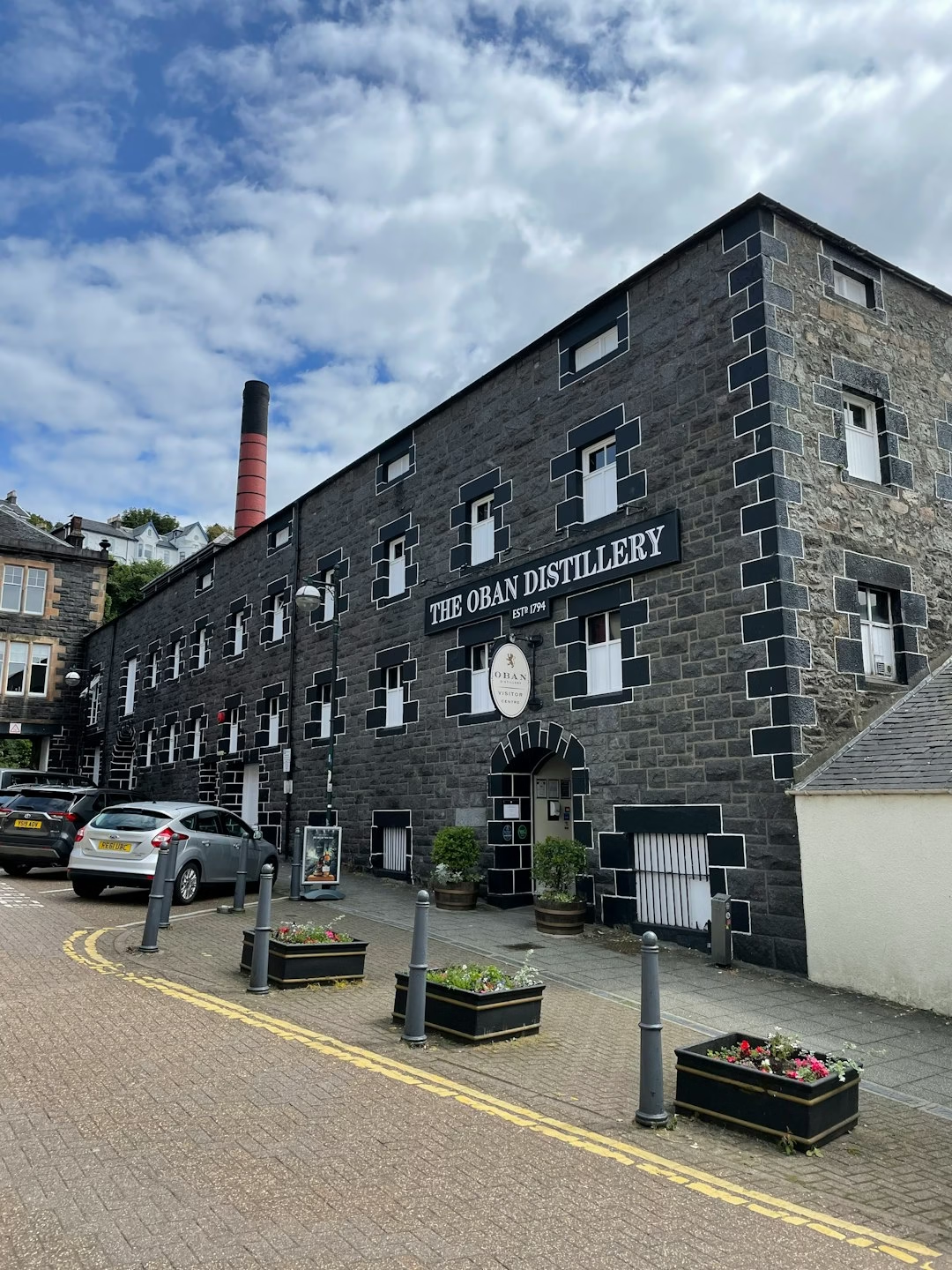
Blending decisions in a distillery are fundamentally about understanding how different aging and production environments have shaped each batch. Knowing that a particular set of barrels spent winter in a warehouse section with cooler temperatures and higher humidity, and that those conditions produced specific characteristics, allows a blender to make informed selections. That kind of environmental history is only available if conditions have been tracked continuously from the moment spirits entered storage.
Nosy monitors temperature, humidity, atmospheric pressure, and CO2 across distillery facilities, logging readings every five minutes and storing historical data accessible through a web-based dashboard. The platform makes it possible to review exactly what environmental conditions a barrel or production batch experienced across its entire aging period. At a craft distillery in Rhode Island, Nosy sensors deployed across barrel aging and production areas are building the environmental history that supports data-informed blending decisions. Distilleries interested in this approach can find more at Nosy for Craft Distilleries.
Conclusion
Environmental history tracking has emerged as a powerful tool for empowering data-driven decisions in blending and storage operations, marking a significant shift towards more sustainable and efficient practices. By leveraging historical environmental data alongside real-time monitoring and advanced analytics, organizations can gain unprecedented insights into the environmental impacts of their operations and make more informed decisions to mitigate these impacts.
The integration of environmental data into sustainable practices offers several key takeaways. Firstly, it enables a more holistic understanding of the complex relationships between operational activities and environmental outcomes. This comprehensive view allows for more targeted and effective sustainability initiatives. Secondly, data-driven approaches facilitate continuous improvement, enabling organizations to track progress, identify areas for enhancement, and adapt strategies in response to changing environmental conditions.
Furthermore, the use of advanced technologies such as GIS, AI, and real-time monitoring systems has significantly enhanced the capabilities of environmental data analysis and management. These tools not only improve the accuracy and timeliness of environmental assessments but also enable predictive modeling and scenario planning, supporting more proactive environmental management strategies.
Looking to the future, the role of data in environmental sustainability is set to become even more central. As data collection and analysis technologies continue to advance, organizations will have access to increasingly detailed and comprehensive environmental information. This will enable more precise targeting of sustainability efforts, more accurate prediction of environmental impacts, and more effective optimization of operations for environmental performance.
The future of environmental management will likely be characterized by highly integrated, data-driven systems that can automatically adjust operations in real-time to minimize environmental impacts while maintaining operational efficiency. This vision of adaptive, responsive environmental management represents a significant evolution from traditional approaches and holds great promise for achieving sustainable development goals.
